
The houses of a sitting and a former MLA, both Dalits, were set afire by a violent mob.

'By beheading an Indian soldier, the Pakistan army has demonstrated its proclivity for barbaric medievalism.' 'The strategies adopted and the punishment inflicted by India must be made progressively more stringent with every new act of terrorism till the cost becomes prohibitive for Pakistan,' says Brigadier Gurmeet Kanwal (retd).

"They support terror operations in India with terrorist organisations. They support the Haqqani network and the Taliban in conducting operations against the United States and NATO and Afghanistan. They've got blood all over their hands with the casualties," General (Retd) Jack Keane said.

'Alas, the Congress party offers no suggestions as to how to unscramble the omlette it cooked during 2004-2014 on which the Modi government may have since lavishly spread some tomato ketchup,' says Ambassador M K Bhadrakumar.

Two people have been killed as protesters on Saturday attacked police posts and security personnel in several areas and targeted BJP office in Kulgam as violence broke out in Kashmir Valley, a day after Burhan Wani, a poster boy of terror outfit Hizbul Mujhaideen, was killed in an encounter.

Stepping up ceasefire violations, Pakistan on Friday resorted to heavy mortar shelling and firing on several BSF posts along the Indo-Pak border in Samba and Kathua districts of Jammu and Kashmir, drawing a strong retaliation from India which killed two Pakistan Rangers.

The kind of freedom Kashmir is enjoying today is not there even in Islamic countries like Afghanistan, Syria, Turkey and Pakistanis, Mufti said.
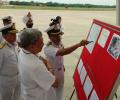
'Other countries go out on a limb to save even a single life.' 'What to talk of civilian accidents and disasters, even our military does not have a priority for Combat Search and Rescue,' says Group Captain P I Muralidharan (retd).
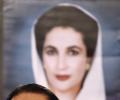
In a golden moment in Pakistan's chequered 66-year political history, President Asif Ali Zardari on Sunday left the presidency after successfully completing his five-year term, paving the way for India-born Mamnoon Hussain to take over.
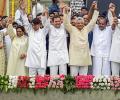
Dubbing the next election a choice between governance and development on one side and chaos on the other, the prime minister cited the example of Karnataka, where the Congress-Janata Dal(Secular) alliance 'stole the mandate' to form government with 'development taking a back seat'.

'When there are two hostile armies operating in close proximity, moral ascendancy is very important -- and that is something, I think, we achieved.' 'What is important is the will and determination of a country.' 'That you are willing to do something about terror that is coming from across the border and that is the message that was sent out.'

'NSA Doval and the PM are known to admire Israel's tough response to cross-border terrorism.' 'However, New Delhi's situation is far more complex than Tel Aviv's, which enjoys military superiority over all its neighbours,' says Ajai Shukla.

In a twin terror attack, three heavily-armed militants dressed in army fatigues on Thursday stormed a police station and an army camp in Jammu region killing nine people including a Lieutenent Colonel, casting a shadow on the upcoming meeting between Prime Minister Manmohan Singh and his Pakistan counterpart Nawaz Sharif.
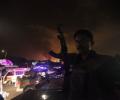
A gun battle was still continuing inside the old airport near the hangars and workshop as military and other security personnel tried to clear up the runaway and surrounding area from the terrorists.

Dr Behera speaks about how the nationwide positive reaction to the abrogation of Article 370 in Jammu and Kashmir indicates that the very idea of India is changing. From a diverse, multicultural entity, could India be becoming a place where assimilation is more important than accommodation?

'Tis the season for hope and for forecasts. So here we look at the things we want and hope will be granted in 2015.
'Over the last year, Bajwa has created the environment to support bold moves on India. The ball is in India's court,' a senior Pakistan military officer tells Ajai Shukla.

'Diplomatic engagement will continue even as India keeps all its options open with respect to discretely targeting the Pakistani military and its terrorist proxies.'

'The situation is in real danger of swinging back to the fearful days of the 1990s, primarily for want of a well thought out action plan in New Delhi.'
Chief Minister Mehbooba Mufti warned that there could be a backlash if the force loses patience.

Rifleman Jaswant Singh Rawat, 21, received the Mahavir Chakra in the 1962 War with China. Such was his valour that a temple and museum stands on the land he died defending in the icy valley of Arunachal Pradesh.

'It should be of concern that some youth in Kashmir have started raising Daesh flags along with those of Pakistan.'

Indian policymakers must incorporate in their nuclear doctrine a realistic response to tactical nuclear warheads, says Ajai Shukla.

Despite a lot of lip service to national unity, functional relations between the Han Chinese immigrants and the Uyghur regional majority have not developed on equitable basis, says R Hariharan
The Indian Army and more recently the Indian Navy have already set up dedicated intelligence branches. It is surprising indeed that the IAF, where real time and timely intelligence is most vital for effective and safe prosecution of the air war, has still not done so itself, says Group Capt (retd) P I Muralidharan.

Eyewitnesses reported hearing a loud "bang" from inside the venue.
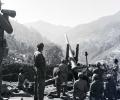
Fifty years ago, India and Pakistan fought a short but bloody war. The author finds out how Sainik Samachar, the defence ministry's journal, reported it.

The year 2014 is coming to an end. It was the year of conflict, the year of strife. Year 2014 will be remembered for several reasons -- the rise and threat of the Islamic State, the downing of two Malayasia Airlines aircraft and the sudden and effective way of using hastags on social media to generate a buzz about the event. After all, who can forget #theicebucket challenge and the phenomenon it grew into. Read on as we bring you an overview of international news and events of 2014.

With cyclone Phailin expected to make landfall in Odisha on Saturday, the state government mounted a massive operation to evacuate two lakh people from six coastal districts on Friday night

The ninth edition of the Global Peace Index, which ranks the nations of the world according to their level of peacefulness, has ranked Syria as the most dangerous country in the world.
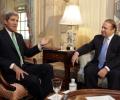
Pakistan Prime Minister Nawaz Sharif continues his exhortation for US mediation in Kashmir, and harks back to his meeting with former Prime Minister Atal Bihari Vajpayee when the latter had agreed to a resolution of Kashmir imbroglio; senior us officials assert there is 'absolutely no change in us policy' that Kashmir has to be resolved bilaterally. Aziz Haniffa reports.

Incidents of arson, firing and vandalism were reported from Madhya Pradesh, Rajasthan, Uttar Pradesh, Bihar and Punjab as protesters agitated against the dilution of the SC/ST Act.

'The problem in Kashmir is not about pellets, bullets or tear gas.' 'It is the government's policy and intention to criminalise the protest.'

'If you invest your entire capital in talks, you cannot abruptly change gear and decide on war.'

While the state's decision to take the road to Prohibition has been given a communal twist, there are several political imperatives of the move
